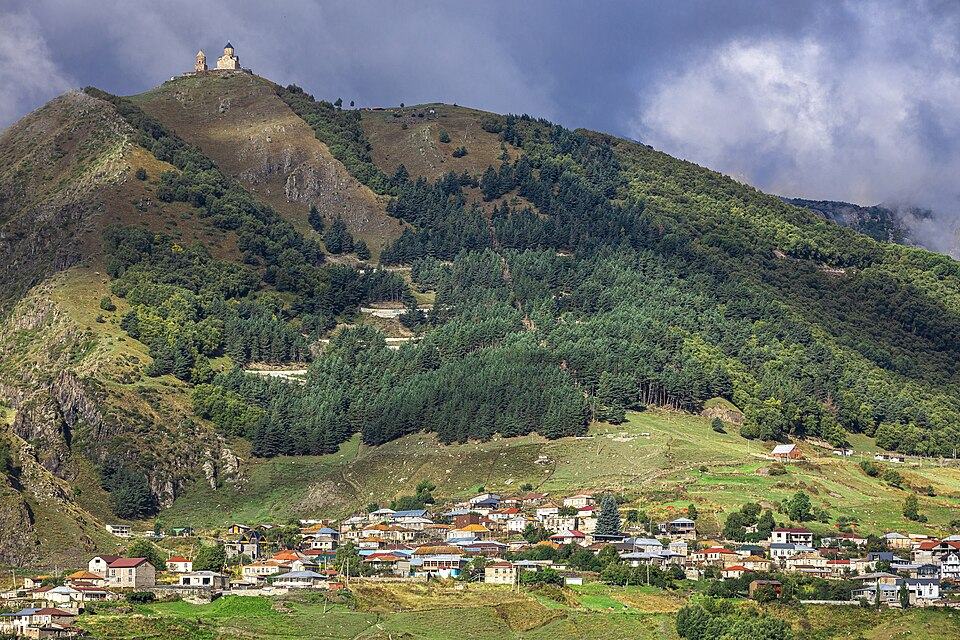
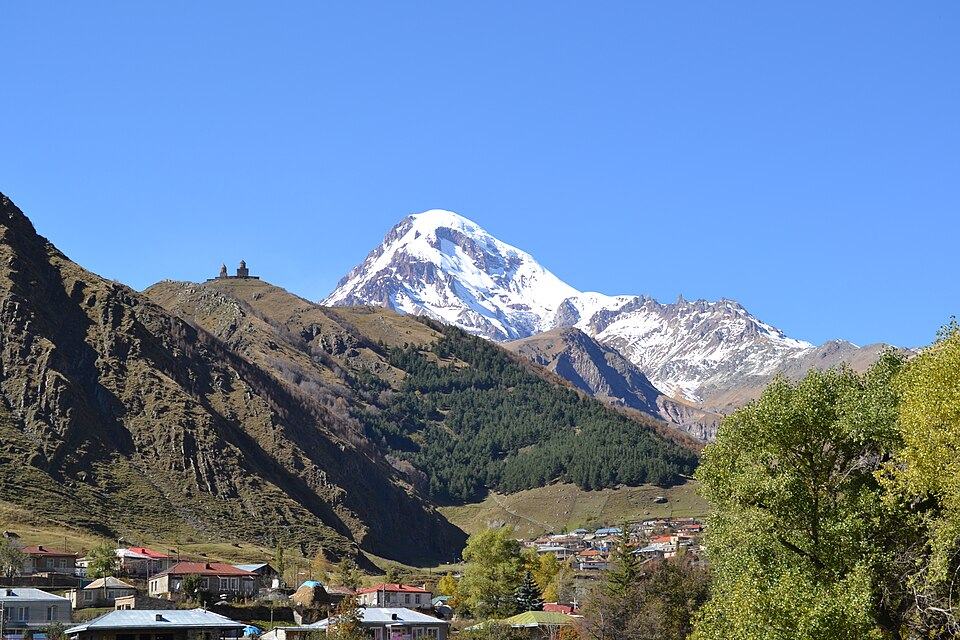
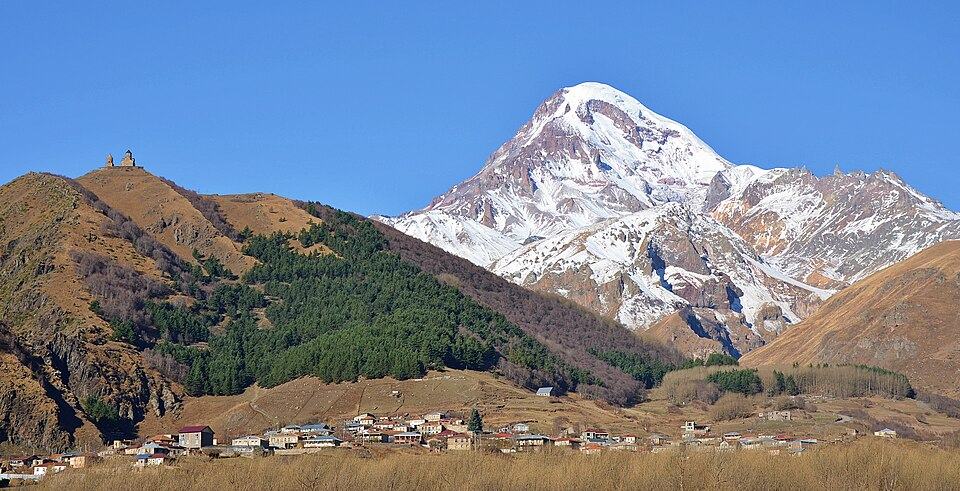
- Kazbegi is the area around Stepantsminda, a town at about 1,740 m roughly 155 km north of Tbilisi, best known for Gergeti Trinity Church under 5,054 m Mount Kazbek.
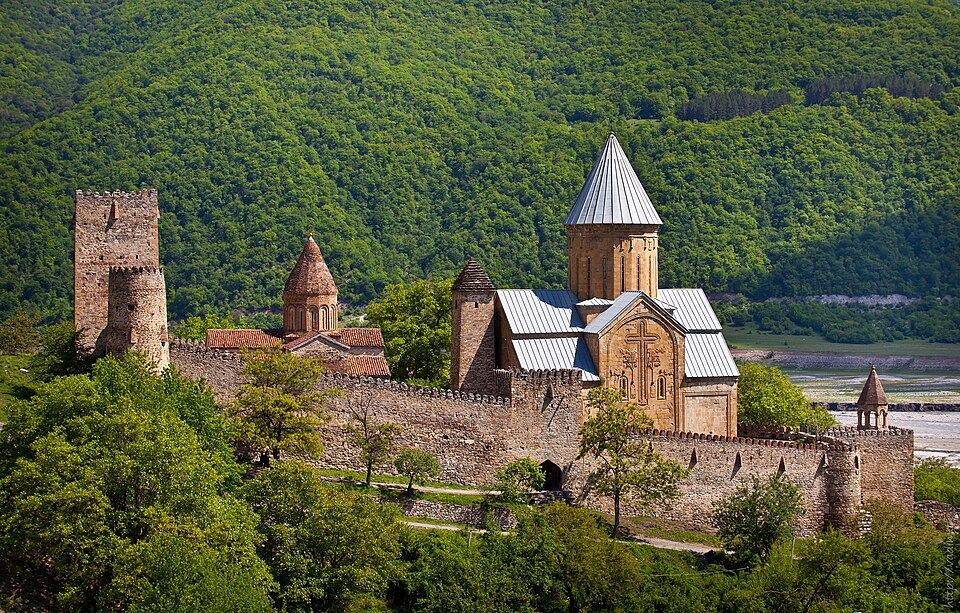
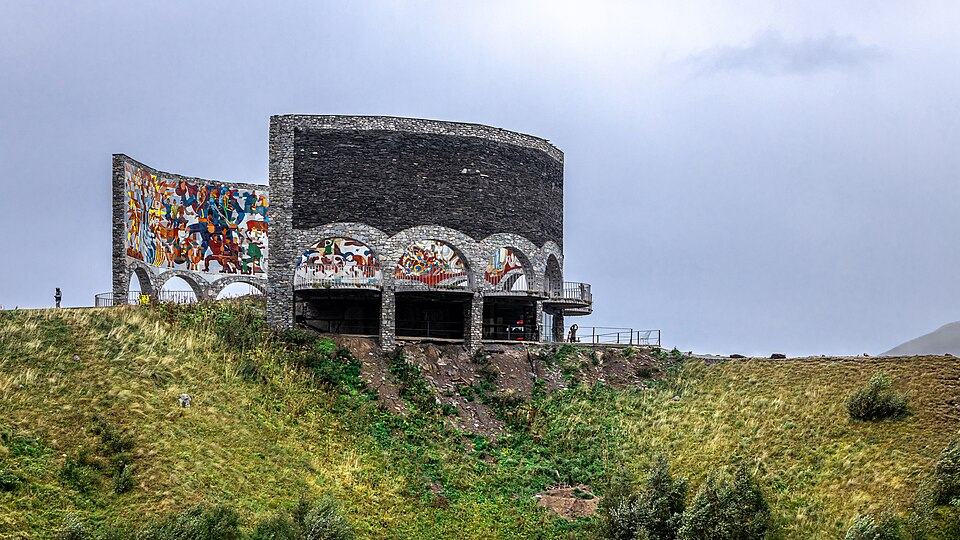
- The Georgian Military Road takes about 3 hours non-stop, or 4 to 5 with stops at Ananuri, Pasanauri, Gudauri and the Friendship Monument.
- The walk up to Gergeti Trinity Church gains about 430 m in 1 to 2 hours, and a 4x4 from the town square does it in about 20 minutes.
- Stay at least one night: Juta and Truso, the two best valley walks, need a full day each and are open roughly June to early October.
Kazbegi is the high valley of the Tergi River on Georgia's border with Russia, and its main town, Stepantsminda, is the best mountain trip you can make from Tbilisi. In about three hours you swap the capital's summer heat for a town at 1,740 m facing Mount Kazbek, with the 14th-century Gergeti Trinity Church on the ridge in between. Most people come for that one view. Those who stay a few nights find side valleys full of wildflowers and empty towers, a glacier within a day's walk, and villages where cows outnumber cars.
This guide covers the whole area, historically called Khevi and largely protected as Kazbegi National Park. It takes you up the Military Road stop by stop, explains the Gergeti hike and the longer push toward the glacier, and sets out the Juta, Truso and Dariali trips. You will also find where to sleep, what to eat, how winter changes things and plans for one to three days. For Mtskheta and Khevsureti, see our Mtskheta-Mtianeti region guide.
Where is Kazbegi, and is it worth visiting?
Stepantsminda is the town; Kazbegi is its Soviet-era name, still used on many signs and for the municipality and national park around it. It lies on the Tergi (Terek) River about 12 km south of the Dariali crossing into Russia, which is why you share the road with long-distance trucks.
The reason to go is high-mountain scenery with very little effort. A paved road delivers you to 1,740 m below Mount Kazbek (5,054 m), a dormant volcano and one of Georgia's highest peaks. Within half an hour's drive lie four very different landscapes: the grassy ridge of Gergeti, the rock spires above Juta, the mineral-stained floor of Truso and the sheer walls of the Dariali Gorge. Summer days stay mild while Tbilisi bakes.
How to get from Tbilisi to Kazbegi
Stepantsminda is about 155 km from central Tbilisi on the Georgian Military Road. The road is paved throughout but climbs above 2,300 m with tight hairpins on the Gudauri side. Without stops the drive takes about 3 hours; hardly anyone drives it straight through, because the best sights are on the road itself.
| Stop | From Tbilisi | Driving time | Why stop |
|---|---|---|---|
| Zhinvali Reservoir viewpoint | about 60 km | about 1 h | Wide view over the turquoise lake |
| Ananuri Fortress | about 70 km | 1 h 15 min | 17th-century castle and churches on the shore |
| Pasanauri | about 90 km | 1 h 30 min | Khinkali lunch where the two Aragvi rivers meet |
| Gudauri | about 120 km | 2 to 2.5 h | Ski resort at about 2,200 m |
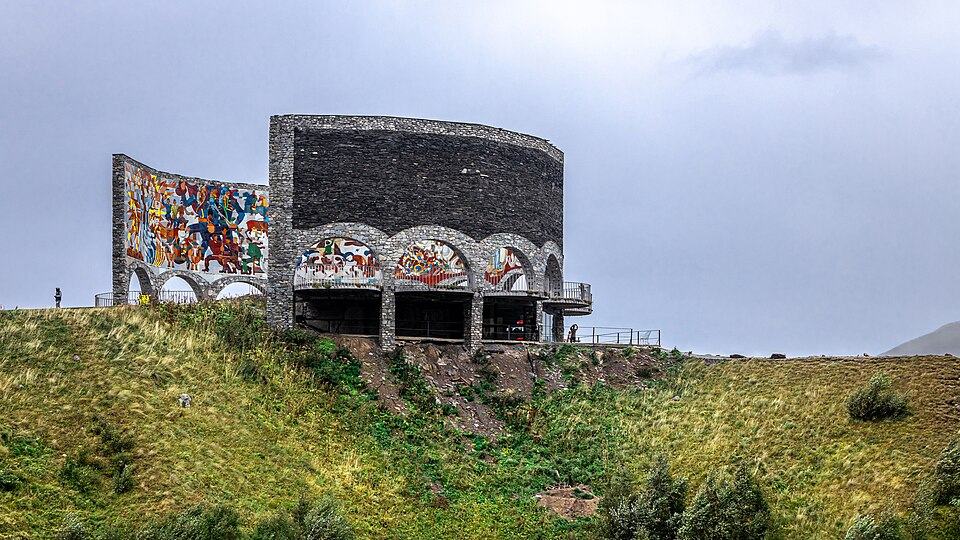
| Friendship Monument | about 125 km | about 2.5 h | Soviet mosaic balcony over the Devil's Valley |
| Jvari Pass | about 130 km | about 2.5 h | Top of the road, 2,379 m |
| Stepantsminda | about 155 km | about 3 h | Town square, guesthouses and 4x4 drivers |
North of the pass, look for the rust-coloured mineral deposits beside the road before Kobi. From there the valley opens out past the villages of Sioni and Sno toward Stepantsminda.
By private driver or tour
A driver is the easiest option for two or more people, because you can stop at viewpoints that buses pass without slowing. Book a one-way transfer with stops if you are staying, and agree beforehand which stops you want. Our Kazbegi day trip follows this route and ends with a 4x4 ride up to Gergeti.
By marshrutka from Didube
Minibuses to Stepantsminda leave from Didube bus station, beside Didube metro in the north of Tbilisi. There are several departures a day, most in the morning, and they tend to leave when full. The ride takes about 3 hours with one short break. Drivers will let you off at Ananuri or Gudauri if you ask, but never wait at viewpoints. Return minibuses leave from the main square in Stepantsminda; ask your guesthouse the evening before for the times.
By shared taxi
Shared taxis also wait at Didube. A driver fills the car with four passengers heading north, which is a little quicker and more comfortable than the minibus. Settle the fare, and whether photo stops are included, before you get in.
Gergeti Trinity Church hike: route, time and the 4x4 option
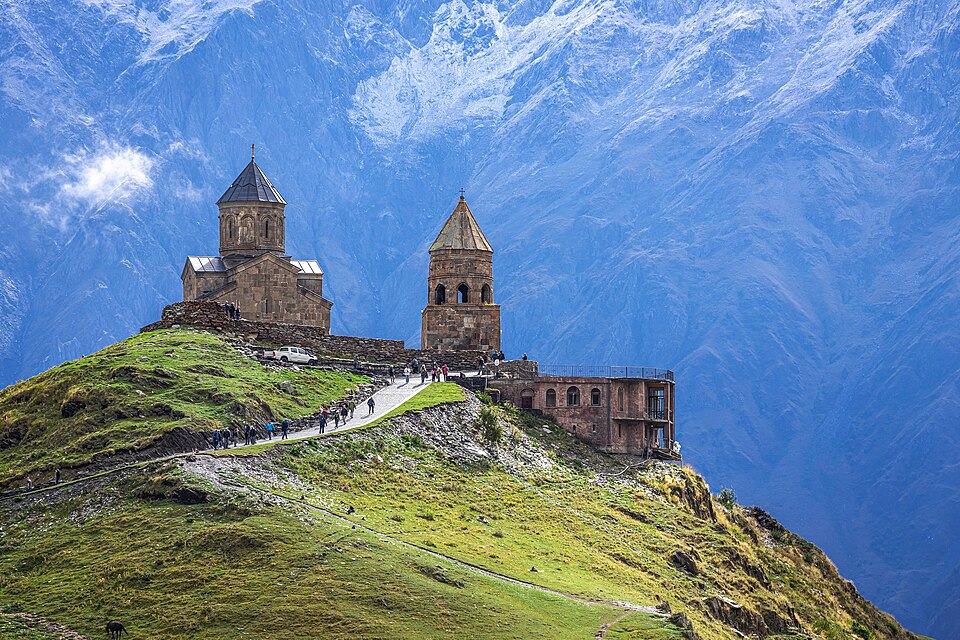
Gergeti Trinity Church, Tsminda Sameba in Georgian, stands at 2,170 m on a bare ridge above the west bank of the river, about 430 m higher than the town square. Cross the Tergi and walk up through the lanes of Gergeti village. Above the last houses a well-worn footpath leaves the road and climbs steeply through patches of woodland and open meadow, cutting off the hairpins. Most walkers need 1 to 2 hours for the climb of about 3 km, and under an hour down.
The path needs no special skill but turns slippery after rain, and near the top it crosses the road several times. Go early: mornings are usually the clearest, and by late morning both cloud and tour groups tend to arrive. If you would rather not walk, 4x4 drivers on the main square run up the paved road in about 20 minutes and wait while you look around; many people ride up and walk down. Cover shoulders and knees, and women should wear a skirt and headscarf inside, which can be borrowed at the gate.
On to the Gergeti Glacier and the Sabertse Pass
The church is also the start of Kazbegi's big day hike. The path continues north across high pasture to the Sabertse Pass, at roughly 2,900 to 3,000 m, where Kazbek suddenly fills the view, then follows a ridge beside the moraine to a viewpoint over the Gergeti Glacier at about 3,200 m. From town the round trip is about 20 km with more than 1,500 m of climbing, 8 to 10 hours on foot; a 4x4 to the church removes the first steep section.
Take plenty of water, food and warm layers. The glacier is crevassed and no place for walkers: going on to the Bethlemi hut or the summit needs glacier skills and a licensed guide. Snow can lie on the upper trail into early summer, and the dependable months are July to September.
Juta valley hike to Fifth Season and the Chaukhi lakes
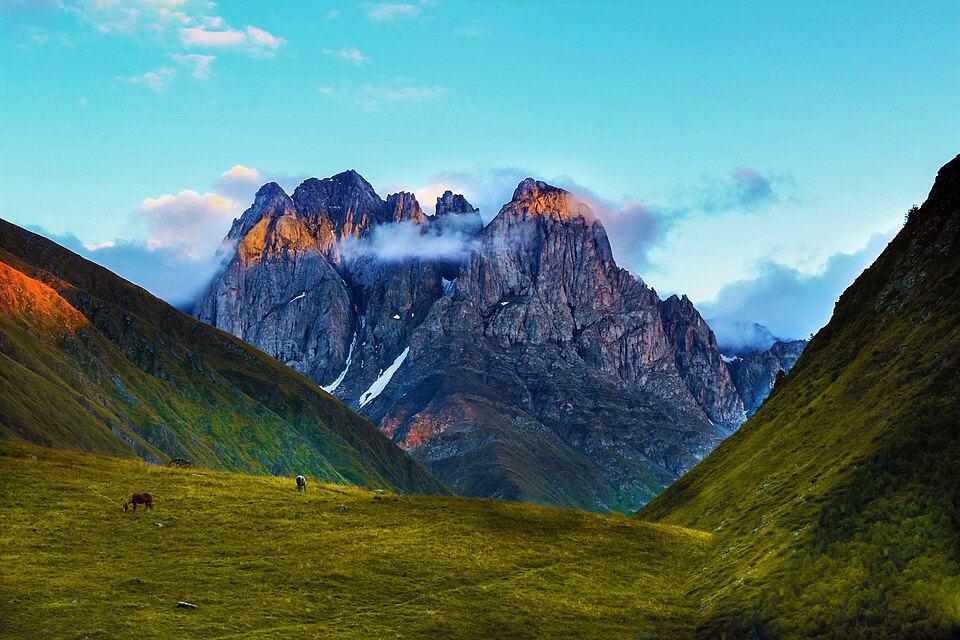
Juta lies about 20 km from Stepantsminda at roughly 2,200 m, at the head of a side valley that leaves the Military Road at Sno. The draw is the Chaukhi massif, a jagged wall of rock towers so unlike the rounded ridges around it that people call it the Georgian Dolomites. The road up from Sno is gravel and steep in places, so use a high-clearance car or 4x4. A section near the village was damaged in 2025: check whether vehicles can reach Juta or stop short, leaving a walk of a couple of kilometres.
From the village, a steep climb of about 1 km brings you to Fifth Season, an alpine hut with rooms, a cafe and a terrace facing the peaks. Beyond it the path eases into a broad meadow along the stream. About 3 km further, a small glacial lake lies below the massif, usually called Chaukhi Lake, though some guides speak of the Chaukhi lakes because of the smaller pools nearby. The round trip from the village is about 12 to 14 km, 4 to 5 hours at an easy pace.
Snow buries Juta for about half the year, and the walking season runs from roughly June to early October. In summer, guesthouses and campsites open in and above the village. Strong hikers cross the Chaukhi Pass (roughly 3,340 m) into Khevsureti, dropping to the Abudelauri Lakes and Roshka, a very long day or an overnight trek; our Kazbegi and Khevsureti trek includes it with a guide and horses for the gear.
Truso valley hike: travertines, Ketrisi and Zakagori
Truso is the upper valley of the Tergi, reached by turning west off the Military Road at Kobi, north of the Jvari Pass. A dirt track leads to Kvemo Okrokana, where most walkers set off, and the route then follows the river through a short gorge onto a wide valley floor at about 2,000 to 2,200 m, with very little climbing. Drivers in Stepantsminda run 4x4 trips that drop you at the start, or further in, and collect you later.
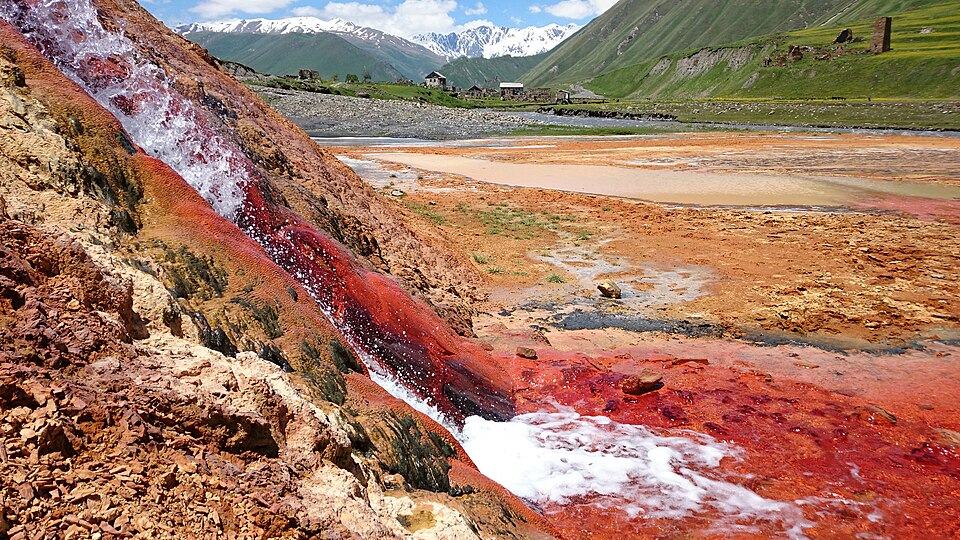
The sights come one after another. First are the travertines, terraces of white, orange and rust-red stone built up by mineral springs. Next is the Abano mineral lake, which bubbles with carbon dioxide; do not drink from it or swim in it. Then come the empty Ossetian villages, the best preserved being Ketrisi with its stone defence tower, and a small restored monastery near Abano village. The track ends below the ruined Zakagori fortress, perched on a rock above the valley.
Kvemo Okrokana to Zakagori and back is about 22 km, 5 to 7 hours on foot, less if a 4x4 carries you past the first stretch. Zakagori is the turning point for visitors: beyond it lies the occupied Tskhinvali region (South Ossetia), and Georgian police control the road. Carry your passport, keep to the main track, and bring a hat, water and lunch, as there is little shade.
Gveleti waterfall, Dariali monastery and the Dariali gorge
North of Stepantsminda the Tergi cuts through the Dariali Gorge, a canyon of rock walls hundreds of metres high. It has been the main passage through the central Caucasus since antiquity, hence its old name, the Caucasian Gates. Today the road ends at the Georgian border checkpoint, so this is a short out-and-back trip.
About 7 km from town, a side valley leads to Gveleti Waterfall. The path starts by a bridge and climbs steeply over rocks and rough steps to a smaller fall, with the main one, around 25 to 30 m high, roughly 750 m further on. Allow 1 to 2 hours there and back, in shoes with grip.
A few kilometres further, Dariali Monastery stands just before passport control. It looks medieval but was begun in 2005, its pinkish-grey churches set against the cliffs. You can visit without crossing the border; do not photograph the checkpoint, and keep your passport with you. Gveleti and Dariali together make a good half day when cloud hides Kazbek.
Sno, Sioni and the villages of Khevi
Sno, a few kilometres south of town, is where the Juta road turns off. At the start of that road stands a group of huge heads carved out of boulders by the local sculptor Merab Piranishvili, portraits of Georgian poets, writers and historical figures.
Sioni, roughly 10 to 12 km south of Stepantsminda, has one of the oldest churches in Khevi: a three-nave stone basilica of the 9th to 10th century inside a walled enclosure, with a four-storey watchtower on the cliff beside it and traces of painting on the west wall. It once guarded the approach to Dariali and makes a quiet 20-minute stop on the way to or from Truso.
Where to stay in Kazbegi, and what to eat
Stepantsminda has the widest choice, from family guesthouses with a handful of rooms to mid-range hotels with Kazbek views and Rooms Hotel, a large design hotel known for its terrace facing the mountain. The centre puts you close to shops, cash machines and the square where drivers gather. Gergeti village, across the river, is quieter and sits at the foot of the church path. For more peace, try Arsha or Sno, a few minutes south, or Juta in summer. Book early for weekends from July to September, and in winter ask about heating before you book.
What to eat in Kazbegi
Mountain food is hearty and simple. Khinkali come here in their plain highland form, with meat, onion and black pepper and no green herbs. Khabizgina, a round pie stuffed with cheese and potato, is a guesthouse favourite. Look also for dambalkhacho, a strong aged cottage cheese from the eastern highlands, local honey, slow-cooked lamb and mtsvadi off the grill. Guesthouse dinners are often the best meals of the trip, so half board is worth booking.
Kazbegi weather, road closures and winter visits
Stepantsminda is roughly 8 to 10°C cooler than Tbilisi. In July and August days typically reach about 18 to 22°C and nights fall toward 10°C, with frequent afternoon storms. Snow usually lies from November or December until March or April. Kazbek is often clear at dawn and hidden by noon.
| Season | What to expect | Best for |
|---|---|---|
| June | Green, snow still high up, showers | Gergeti, Gveleti, lower Truso; Juta from mid-month |
| July to August | Warmest and busiest, afternoon storms | Every hike, including the glacier |
| September to mid-October | Settled days, cold nights, autumn colour | Juta and Truso with fewer people |
| Late October to November | First snow, some guesthouses close | Quiet visits; check the road |
| December to March | Deep snow, possible pass closures | Gergeti under snow, skiing at Gudauri |
| April to May | Thaw, mud, avalanche risk | The town and church; valleys mostly closed |
The Military Road is normally kept open through the winter, but the stretch over the Jvari Pass, between Gudauri and Kobi, closes after heavy snow or when avalanche danger is high, usually for hours and occasionally for days. Check with your driver or guesthouse, or official road updates, before leaving Tbilisi, and keep a spare day at the end of a winter trip. A new road with long tunnels between Kvesheti and Kobi is being built to bypass the most exposed section; check whether it has opened when you travel.
Kazbegi in winter
Winter rewards flexible travellers. The town and the church under snow look superb, the 4x4s still drive up once the church road has been cleared, and the footpath becomes a real snow walk needing boots with grip or microspikes. Juta and Truso are generally cut off and exposed to avalanches, so save them for summer.
Skiing at Gudauri
Gudauri, about 35 km before Stepantsminda, is Georgia's largest ski resort, with lifts to about 3,280 m, wide pistes for intermediates and plenty of freeride terrain. The season usually lasts from December to April. Stay in Gudauri and visit Kazbegi on a clear day, or stay in Stepantsminda and drive over the pass to ski; a gondola from Kobi also connects to the Gudauri lifts.
Mountain safety in Kazbegi
Kazbegi's popular walks are not technical, but they are real mountain terrain, and help can take a long time to arrive.
- Start long hikes early and turn back if cloud builds: summer storms with lightning and hail are common above 2,500 m.
- Carry a warm layer, waterproof, hat, sunscreen and water, and treat stream water, as livestock graze almost everywhere.
- Download an offline map before you leave town; mobile signal is good in Stepantsminda but patchy in the side valleys.
- Shepherd dogs guard flocks on high pasture. Do not run: stop, stay calm and wait for the shepherd to call them off.
- Stay off the Gergeti Glacier unless you are with a qualified guide and the right equipment.
- Carry your passport in Truso and at Dariali, and go no further than Zakagori or the Dariali checkpoint.
- Georgia's emergency number is 112. Tell your guesthouse where you are going and when you expect to be back.
How many days in Kazbegi? 1, 2 and 3-day plans
One night is the minimum we suggest, and two or three are ideal. These plans assume summer; in winter swap the valley hikes for snow walks or a ski day.
- 1 day: the classic day trip
Leave Tbilisi by 8 am, pause at the Zhinvali lookout, Ananuri and the Friendship Monument, eat khinkali in Pasanauri, and ride a 4x4 up to Gergeti. Head back by late afternoon. Expect 10 to 11 hours with about 6 in the car. - 2 days: Gergeti in good light and one valley
Day 1: drive up with stops and walk to the church for the evening light. Day 2: go to Juta early for the walk to Fifth Season and Chaukhi Lake, see the stone heads in Sno, and stop at Sioni on the drive back. - 3 days: add Truso or the glacier
Days 1 and 2 as above, adding Gveleti and Dariali on day 2 if you have energy. Day 3: walk the Truso valley, which pairs neatly with the drive home because Kobi is on the way to Tbilisi, or hike toward the Gergeti Glacier and stay a final night.
Our Classic Georgia tour spends two nights in Stepantsminda within a week that includes Tbilisi and Kakheti, and our 7-day Georgia itinerary shows how Kazbegi fits into a first visit.
Kazbegi FAQ
Is Kazbegi worth visiting?
Yes. It is the easiest way to reach the high Caucasus from Tbilisi, and Gergeti Trinity Church under Mount Kazbek is one of Georgia's defining views. Stay a night or two to add the Juta and Truso valleys.
How do I get from Tbilisi to Kazbegi by public transport?
Take a marshrutka from Didube bus station; it takes about 3 hours and ends on the main square in Stepantsminda. Shared taxis from Didube are a little faster and leave when they have four passengers.
How long does it take to walk up to Gergeti Trinity Church?
Most people need 1 to 2 hours from the centre of Stepantsminda, climbing about 430 m through Gergeti village, and under an hour to come down. A 4x4 takes about 20 minutes.
Can you visit Kazbegi in winter?
Yes. The town and the church can be reached for most of the winter. The Jvari Pass sometimes closes after heavy snow, so keep your dates flexible, and expect Juta and Truso to be out of reach until late spring.
Which is better, Juta or Truso?
Juta has the more dramatic peaks and a shorter walk of 4 to 5 hours. Truso is longer and flatter, with travertines, abandoned towers and Zakagori fortress. With two full days, do both.
Do you need a 4x4 in Kazbegi?
Not for the town, the church road or Gveleti. For Juta and Truso a high-clearance vehicle or 4x4 is strongly advised, and drivers on the main square make these trips every day in season.
Is it safe to hike near the Russian border in Kazbegi?
Yes, on the established routes. Carry your passport, turn back at Zakagori and at the Dariali checkpoint, and do not photograph border facilities. Weather and steep ground are the bigger risks.