Kazbegi & Khevsureti Trek
Acclimatise on Kazbegi trails, cross the 3,340 m Chaukhi Pass out of Juta to camp at the Abudelauri Lakes, then reach the tower villages of Shatili and Mutso.
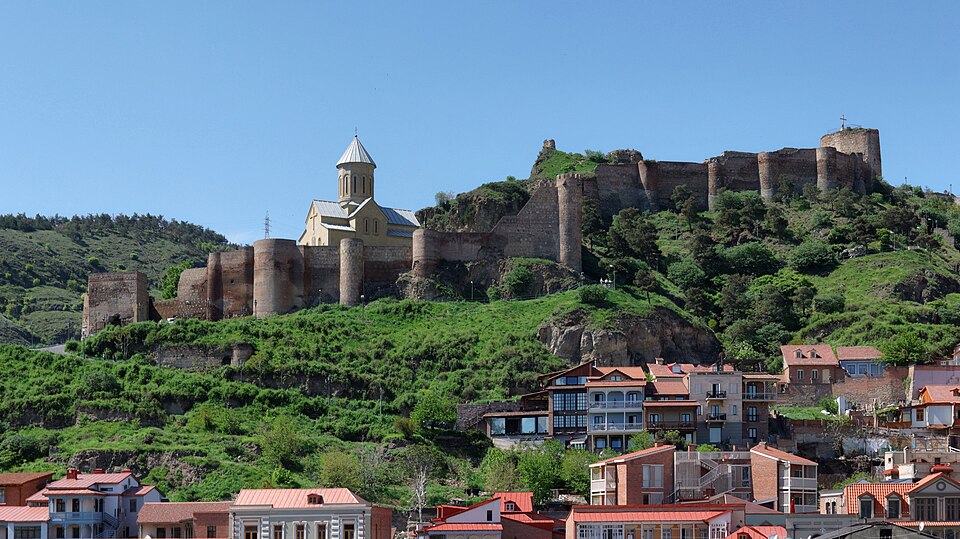 Old Tbilisi (Kala)Photo: Alexxx1979, CC BY-SA 4.0
Two of the least-visited corners of the Greater Caucasus are joined on this route. The first days are spent around Kazbegi, getting used to the altitude on walks above Gergeti Trinity Church and along the Truso Valley. From Juta you then climb over the Chaukhi Pass, roughly 3,340 m, and drop into Khevsureti to pitch camp beside the three Abudelauri Lakes, which lie under the glaciers. Vehicles carry you from Roshka across the Datvisjvari Pass to Shatili, a stone-towered stronghold close to the Chechen border, and on to the clifftop towers of Mutso. Very few travellers make it this far, and Khevsur villages still hold on to many old traditions.
Expect a tough trip suited to experienced hill walkers. Crossing Chaukhi means a long day on steep, rocky terrain where snow patches may linger, and you sleep one night under canvas. Your mountain guide carries communication gear, while horses or a support vehicle haul the camping kit. We run the trek from July to mid-September, the window when the pass is normally clear of snow and the road to Shatili is passable.
Highlights
- Hauling over the Chaukhi Pass, about 3,340 m, on the way from Juta into Khevsureti
- A night in camp beside the green, blue and white Abudelauri Lakes
- Climbing past Gergeti Trinity Church toward the Gergeti Glacier
- Mineral springs and deserted villages along the Truso Valley
- The stone defensive towers of Shatili village
- Mutso's clifftop towers high over the Andaki River
- The rough road over the Datvisjvari Pass into Khevsureti
Tour facts
This trek needs full mobility and good fitness: the core days are on steep, rocky, unmarked ground far from roads. Travellers with reduced mobility could see Gergeti, Juta and Shatili by vehicle on a custom driving itinerary instead.
Places on this tour
18 places · tap any place to read its guide
- 1Tbilisi: arrival and kit check
- 2North to Stepantsminda and a climb to Gergeti
- 3Up to the Sabertse Pass for Gergeti Glacier views
- 4The Truso Valley, then round to Juta
- 5Crossing day: Chaukhi Pass to the lakes
- 6White Lake, Roshka and the drive to Shatili
- 7
- 8Down the Aragvi to Mtskheta and Tbilisi
- 9Free morning and flight home
Day by day
01Tbilisi: arrival and kit checkOvernight: Tbilisi
We collect you at the airport, and your mountain guide joins you for a briefing on the route and a look at your boots and gear. Later in the afternoon, loosen up after the flight with a walk around Old Tbilisi: climb to Narikala Fortress, come down past the Abanotubani sulphur baths and wander the lanes of Kala. Dinner is at a restaurant that cooks food from the mountain regions ahead, khinkali among it, and your guide explains the beer and bread traditions of Khevsureti. This is your last chance to pick up snacks or gas canisters in the city.
02North to Stepantsminda and a climb to GergetiOvernight: Stepantsminda
Head north on the Georgian Military Highway, breaking the drive at Ananuri Fortress beside the Zhinvali Reservoir, then go over the Jvari Pass (2,379 m) and down into the Tergi valley. Lunch is in Stepantsminda, which sits at about 1,750 m. Afterwards, take the old footpath up to the Gergeti church (2,170 m), gaining roughly 400 m through birch woodland and grazing land. Mount Kazbek, 5,054 m high, fills the sky behind the church terrace. Then it is downhill to the village for dinner and a first night in the mountains.
03Up to the Sabertse Pass for Gergeti Glacier viewsOvernight: Stepantsminda
A 4x4 drops you at Gergeti Trinity Church early in the morning. From there the trail heads north-west over alpine meadows and climbs a moraine ridge, rising at a steady gradient to the Sabertse Pass at around 3,000 m. Below you, the tongue of the Gergeti Glacier spills down from Mount Kazbek. The path carries on toward the climbers' huts and the summit route, but today you turn round here and retrace your steps. Allow six to eight hours and about 850 m of ascent, a useful rehearsal for the Chaukhi Pass.
04The Truso Valley, then round to JutaOvernight: Juta (guesthouse)
Drive down to Kobi, where a 4x4 takes you to Ketrisi at the mouth of the Truso Valley. On foot, follow the infant Tergi River past fizzing mineral springs, rust-coloured travertine terraces and the towers of deserted Ossetian villages until you reach Zakagori fortress, where the valley ends at the boundary line. The distance is long, but the ground is almost flat. After the walk, the vehicle loops round to Sno and climbs the side valley to Juta, at roughly 2,150 m, under the jagged Chaukhi towers. You sleep in a guesthouse in Juta.
05Crossing day: Chaukhi Pass to the lakesOvernight: Camp by the Abudelauri Lakes
Today is the crux of the trek. From Juta, walk up the valley under the Chaukhi massif, then climb hard up loose scree and broken rock to the Chaukhi Pass, roughly 3,340 m; reaching it takes four to five hours. Snow can still cover parts of the route in July. On the far side the trail drops into Khevsureti and heads for the Abudelauri Lakes: three glacial pools tinted green, blue and white because each has a different source. The support team will already have pitched the tents by the Green Lake. Plan on eight to nine hours with around 1,200 m of climbing.
06White Lake, Roshka and the drive to ShatiliOvernight: Shatili (guesthouse)
Start the morning with a climb to the White Lake, set beneath the glaciers of the Chaukhi massif, then follow the meadows down to Roshka, a Khevsur village at around 2,000 m; this takes two to three hours. Your vehicles wait in Roshka. The road runs down to Barisakho, then turns north and climbs a steep dirt track through Pirikiti Khevsureti to the Datvisjvari Pass, about 2,680 m. You reach Shatili late in the afternoon and check in to a guesthouse within or next to the old tower complex.
07A day among the towers of Shatili and MutsoOvernight: Shatili (guesthouse)
Spend the morning exploring Shatili, roughly sixty stone towers and dwellings fused together on a rock over the Argun River. Built from the medieval period onward, the village guarded this frontier against raiders from the north. Next, drive up the Andaki valley and make the steep climb to Mutso, a fortress village strung along a ridge, with tower houses and stone burial crypts; it has been partly restored, though its families left long ago. Continue on foot along the Andaki toward Ardoti, then return to Shatili for your final mountain evening.
08Down the Aragvi to Mtskheta and TbilisiOvernight: Tbilisi
Cross the Datvisjvari Pass southward and follow the Aragvi valley down until you join the Georgian Military Highway. A stop in Mtskheta, Georgia's former capital, gives you time at Svetitskhoveli Cathedral and at Jvari Monastery, which looks over the point where the Aragvi flows into the Mtkvari: a calm way to close the walking part of the trip. You reach Tbilisi late in the afternoon and check in. That evening, ease your legs with a private soak at the Abanotubani sulphur baths, then raise a few glasses to the mountains at a farewell dinner with your guide.
09Free morning and flight home
Breakfast is followed by free time in Tbilisi if your flight is later in the day. Near the hotel you could browse the Dry Bridge Market, where stalls sell Soviet badges, old maps and silver jewellery made in the Khevsur style, or linger over coffee on Rustaveli Avenue. When it is time, your driver takes you to Tbilisi airport. Want to stay longer? We can add a day in Kakheti after the trek to taste wine made in qvevri.
Prices
Price per person for a private tour, by the size of your group. Sample prices
| Group size | Per person | Whole group |
|---|---|---|
| Solo traveller | $3,465 | $3,465 |
| 2 travellers | $2,100 | $4,200 |
| 3-4 travellers | $1,680 | from $5,040 |
| 5-8 travellers | $1,385 | from $6,925 |
| 9-15 travellers | $1,155 | from $10,395 |
Room and children
- Single room supplement: $260
- Children under 6 free (sharing a bed); ages 6-11 pay 70% of the adult price.
- Prices change with hotel level and season; your quote is final.
Popular add-ons
- Tbilisi airport transfer (car, 1-3 people)$30
- Extra night in Tbilisi with breakfast$80
- Supra dinner with folk music$60
What's included
- Arrival and departure transfers at Tbilisi airport
- A licensed mountain guide in your language for the whole trek
- Private car and driver, switching to 4x4 for Truso, Juta and Khevsureti
- Eight nights' lodging: hotels, guesthouses and one camp night
- Every meal from day 1 dinner to day 9 breakfast
- Tents, sleeping mats and camp kitchen equipment
- Horses or vehicles to transport luggage and camping gear
- Border police registration for Khevsureti where needed
- Satellite communicator and first-aid kit carried by the guide
- Flights to and from Georgia
- Travel and trekking insurance that covers mountain rescue
- Sleeping bag (we can rent you one on request)
- Drinks apart from tea and water
- Gratuities for your guide, driver and horsemen
Good to know
Who it's for
- Seasoned hill walkers who have done long days above 3,000 m and want a real crossing, not a loop
- Trekkers who want to get beyond the Kazbegi crowds into Khevsureti, one of the least-visited regions of the country
- People who love fortified villages and want to sleep in Shatili, among its stone towers
- Small groups of friends happy with one night in a tent and simple village guesthouses
If you have never walked eight hours over rough ground or you dislike scree, choose the Svaneti Trek: Mestia to Ushguli, which follows village paths and sleeps every night in a guesthouse.
What to bring
- Broken-in boots with ankle support and a firm sole for the loose rock below the Chaukhi Pass
- Trekking poles, which save your knees on the long drop from the pass toward the Abudelauri Lakes
- A sleeping bag comfortable to about minus 5°C for the camp at roughly 2,500 m
- A waterproof jacket and overtrousers, since afternoon storms build quickly over Chaukhi in July and August
- Warm hat, gloves and a fleece or down layer for the pass and the evenings in Shatili
- Sunglasses, high-factor sun cream and a sun hat for long hours above the treeline
- Your passport, carried every day, for the border police checks on the road to Shatili
- Shatili and Mutso lie in a border zone near Chechnya. Police may check documents on the road, so keep your passport on you.
- If snow or a storm makes the Chaukhi crossing unsafe, your guide decides on the day and the group drives round to Roshka instead, keeping the lakes as a walk from that side.
- The Datvisjvari Pass road is a rough dirt track. Rain or an early snowfall can close it for a day or more, so leave a spare day before an onward flight if you can.
- Phone signal is weak or absent between Juta and Shatili. Your guide carries communication equipment for emergencies.
Walking days in numbers
| Day | Distance | Up | Down | Hours | Highest point |
|---|---|---|---|---|---|
| 2 | 7 km | +420 m | −420 m | 3-4 | 2,170 m |
| 3 | 14 km | +850 m | −850 m | 6-8 | 3,000 m |
| 4 | 12 km | +250 m | −50 m | 4-5 | 2,200 m |
| 5 | 13 km | +1,200 m | −850 m | 8-9 | 3,340 m |
| 6 | 8 km | +300 m | −800 m | 2-3 | 2,850 m |
| 7 | 6 km | +300 m | −300 m | 3-4 | 1,900 m |
Guest reviews
Questions about this tour
How difficult is the Chaukhi Pass crossing?
It is the toughest day of the trek: eight to nine hours on the move, a climb of around 1,200 m, then a steep descent over loose rock. You need no technical climbing skills, but you should feel sure-footed on scree, and trekking poles make a big difference.
Do I need a permit to visit Shatili?
Shatili and Mutso sit inside a border zone near Chechnya, and border police check papers on the road in. If registration is needed, we take care of it ahead of time using your passport details. Keep your passport with you on every day of the trek.
What is camping like?
Our support crew pitches two-person tents along with a kitchen tent and a toilet tent, and prepares hot meals. At about 2,500 m beside the Abudelauri Lakes, night temperatures can fall to around freezing, so pack a sleeping bag rated to roughly minus 5°C.
Can the trek run in June or late September?
In June, snow often still blocks the Chaukhi Pass. From late September the weather turns less predictable, and an early snowfall can shut the Shatili road. July to mid-September is the window we consider safe.